base jumping
BASE Jumping at the Perrine Bridge: Twin Falls' Most Iconic (and Legal) Thrill
BASE Jumping at the Perrine Bridge: Twin Falls' Most Iconic (and Legal) Thrill
I was having coffee on my kayak — paddle across my lap, drifting in the shadow of the canyon wall — when I heard the sound.
A whomp of air. A canopy snapping open.
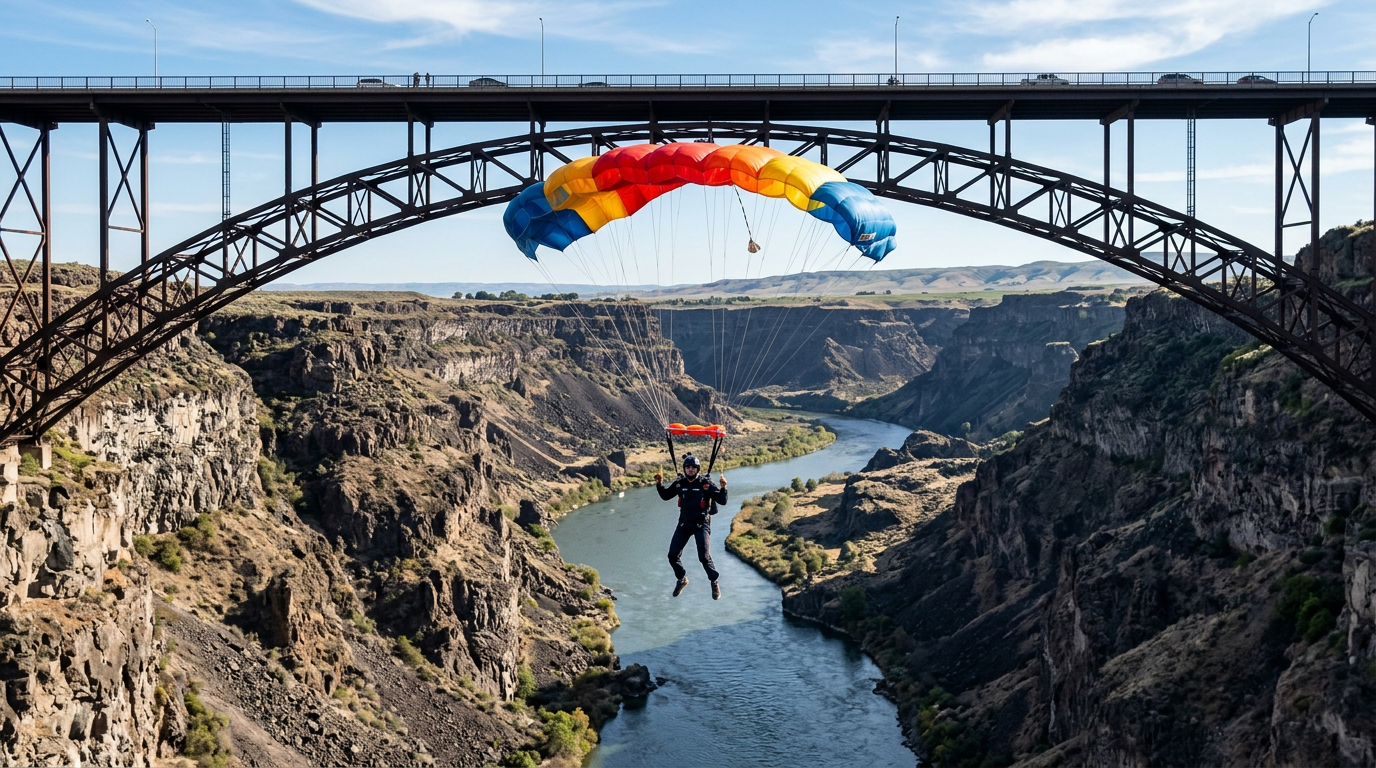
I looked up and a BASE jumper was directly above me, maybe 300 feet up, their chute fully deployed, swinging in slow pendulum arcs toward the landing zone on the canyon floor.
From 486 feet up, they had jumped off the Perrine Bridge, fallen for about four seconds in freefall, deployed their parachute, and were now floating down into the canyon with the casual ease of someone who does this regularly.
Which they probably do. Because this is Twin Falls. And at the Perrine Bridge, this is legal every single day of the year.
The Only Bridge of Its Kind in the U.S.
The Perrine Bridge is one of only a handful of places in the United States where BASE jumping — from a fixed object, not a plane — is legal without a permit, year-round, open to anyone who meets the skill requirements set by the local BASE community.
There is no government agency issuing jumping permits. There is no seasonal closure. There is no ban.
This is the result of a relationship between the Twin Falls community and the BASE jumping community that has evolved over decades — built on mutual respect, self-regulation by experienced jumpers, and a city that has chosen to embrace rather than restrict the activity that makes the Perrine Bridge genuinely world-famous among extreme athletes.
What to Expect as a Spectator
The best place to watch is the canyon floor landing zone, accessible from Centennial Waterfront Park. From there, you look straight up at the bridge deck and watch jumpers step off, fall, and deploy.
On a busy day — weekends in summer — you might see 10 to 20 jumps in an hour. On a quiet day, you might wait 30 minutes and see one.
Here's what I notice every time: the reaction of first-time spectators. There is always a moment — right when the jumper steps off — where every person watching goes absolutely silent. And then the canopy opens and everyone exhales at once.
You can also watch from the bridge itself. Pull off on either end of the Perrine Bridge and walk the pedestrian path. You'll see jumpers staging at the railing, waiting for the right moment, communicating with spotters on the canyon floor.
From a Kayak
Obviously, the best place to watch BASE jumping at the Perrine Bridge is from a kayak directly below it.
I have watched dozens of jumps from the water. The perspective is incomparable — you see the tiny figure at the railing, the drop, the freefall, the deployment, the full swing of the canopy above you, and then the gentle landing on the canyon floor nearby.
It is one of the great free spectacles of Southern Idaho, and it is available to anyone willing to put a kayak in the water.
What This Says About Twin Falls
I use the BASE jumping story in real estate conversations because I think it reveals something important about this community: Twin Falls is a place that has chosen to say yes to remarkable things.
Saying yes to BASE jumping when other cities would have banned it. Saying yes to a canyon lifestyle when other places would have fenced it off. Saying yes to an outdoor culture that asks residents to engage with the landscape rather than just drive past it.
That is the community I chose to build my life and career in. If it sounds like the kind of place you want to be — let's talk.
Dr. Ron Jones | Rim & River Real Estate | rimandriver.com | 208-712-8386