waterfall
Canyon Wall Waterfall: Where the Snake River Meets Thousand Springs Near the Perrine Bridge
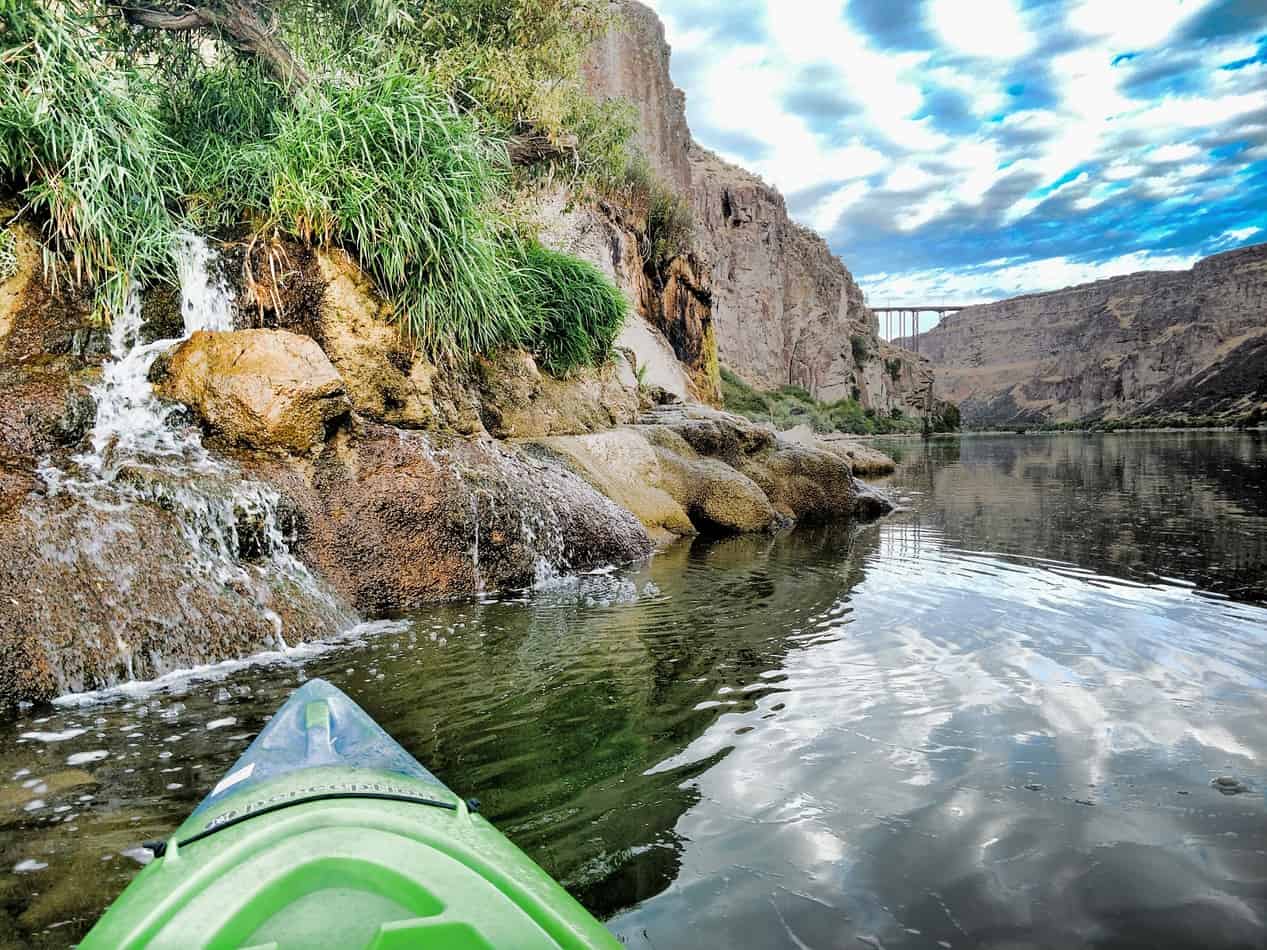
Canyon Wall Waterfall: Where the Snake River Meets Thousand Springs Near the Perrine Bridge
I paddled up to this waterfall and let it rain on me.
The water was cold — maybe 55 degrees — and it came off the canyon wall in a wide curtain, catching the light and breaking it into a fine mist that settled on my kayak and my jacket and my camera lens. In the distance, you can see the arch of the Perrine Bridge against a cloudy sky.
This photo was taken by me — Dr. Ron Jones — from my green kayak on the Snake River in Twin Falls County. The waterfall is one of several spring-fed falls that emerge directly from the basalt canyon wall, fed by the Eastern Snake Plain Aquifer that runs beneath the entire region.
This is not a seasonal waterfall. It runs year-round. It has run for thousands of years. And you can only reach it by kayak.
Spring-Fed Waterfalls of the Snake River Canyon
Most waterfall guides focus on Shoshone Falls — the "Niagara of the West" — which is spectacular and worth every visit.
But the spring-fed falls along the canyon wall are something different. They're smaller, quieter, and they exist in a kind of suspended permanence that Shoshone Falls — dependent on upstream dam releases — doesn't have. These falls run because the aquifer runs. And the aquifer doesn't stop.
Here's the geology: the canyon wall in this section is stratified basalt, laid down in successive lava flows over millions of years. Each flow boundary creates a layer of fractured rock that the aquifer water moves through. Where those boundaries intersect the canyon wall, water emerges — sometimes as a seep, sometimes as a spring, sometimes as a full waterfall.
The vegetation you see at the top of the falls — the thick green growth over