Substack
Every Morning My AI Reads My Gmail, Scans My Calendar, and Hands Me a Battle Plan — Before I Drink My Coffee
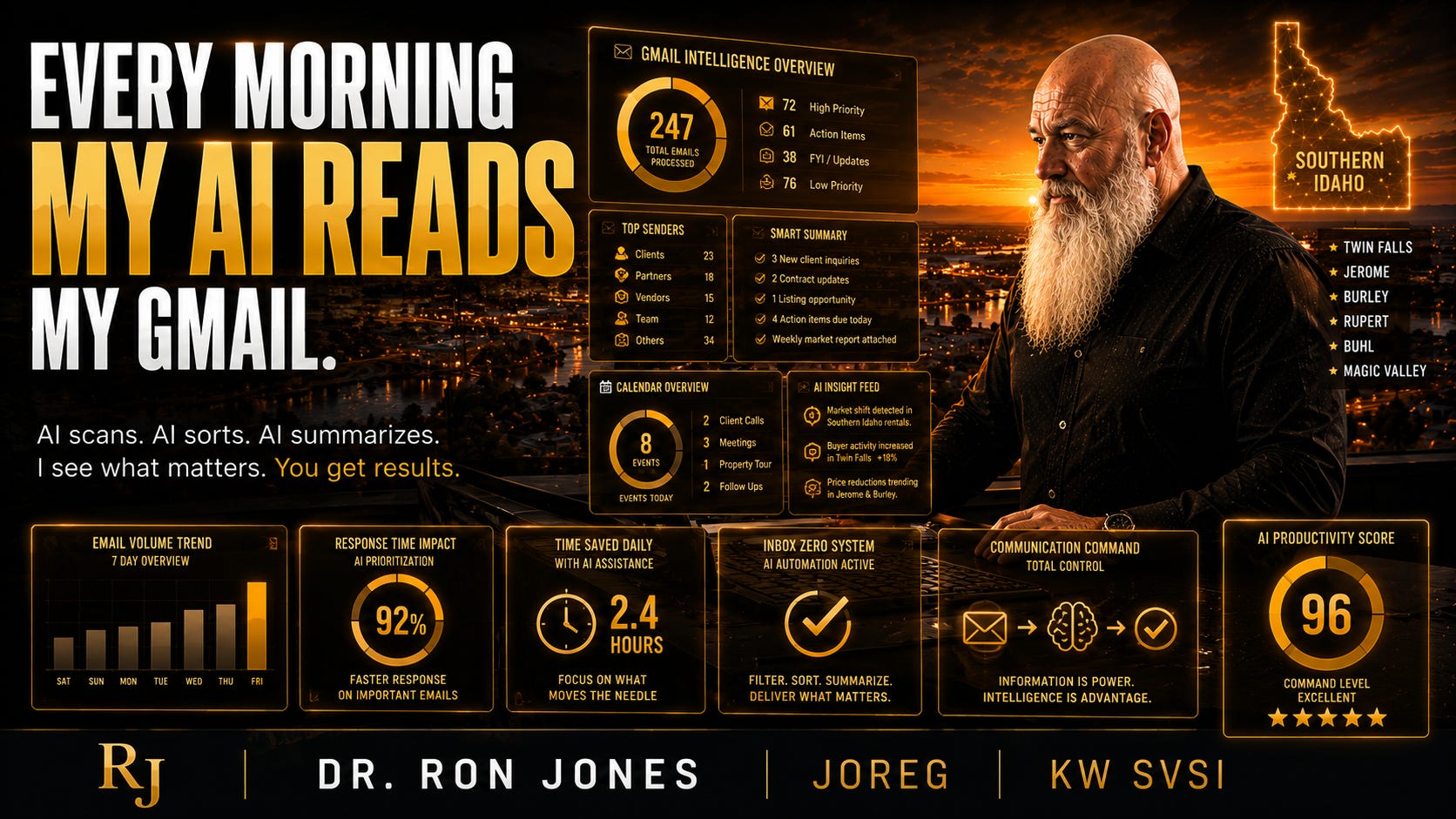
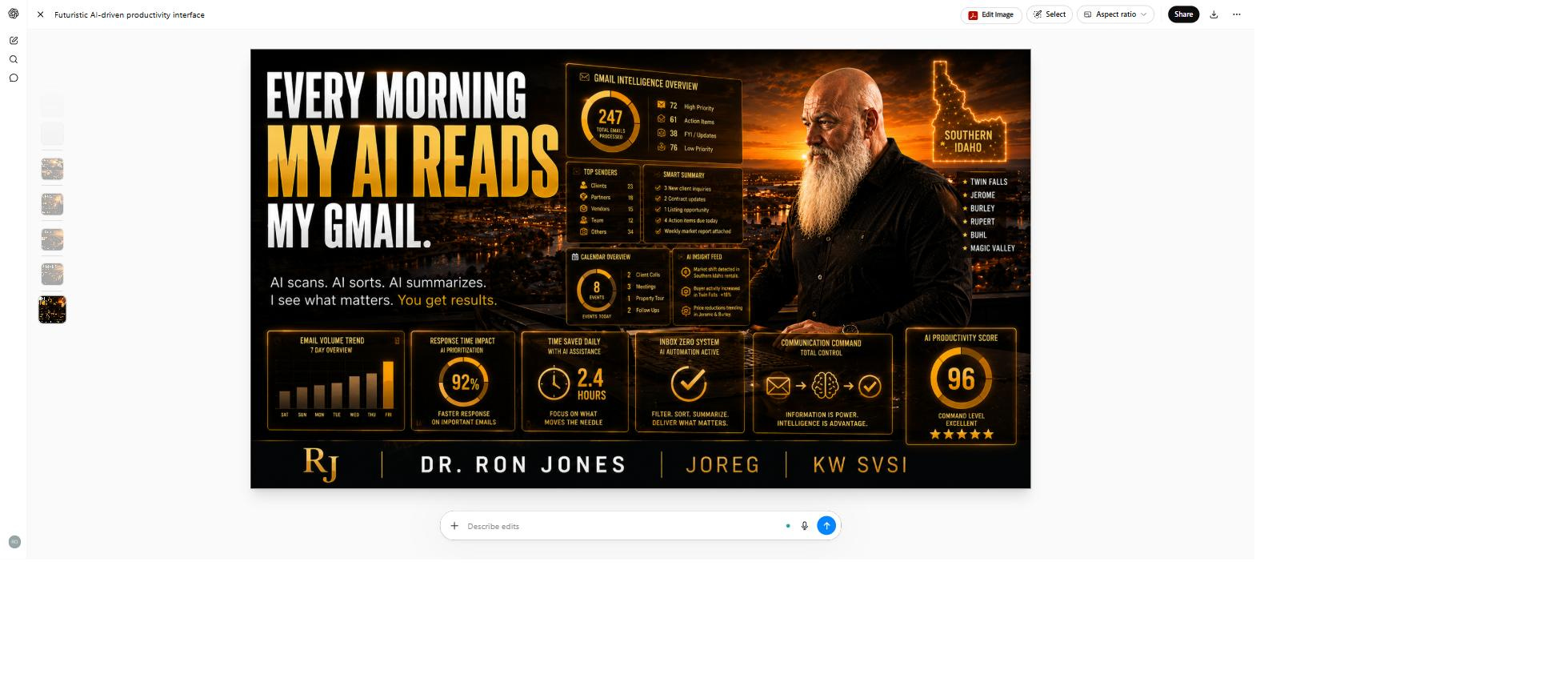
Ask most real estate agents what they do first thing in the morning and they’ll tell you something like “check my phone” or “scroll Zillow.” That’s reactive. That’s flying blind. I don’t do that anymore.
Every morning, before I’ve made a single call or sent a single text, an AI agent named Maya has already scanned my Gmail, pulled my Google Calendar, and compiled a structured 13-section intelligence report and saved it as a formatted email draft in my inbox. I call it the Daily Intelligence Brief — or the DIB. It tells me exactly who is hot, what’s fallen through the cracks, which deals are at risk, what my income forecast looks like, and what my top 10 priorities are for the day.
I’m Dr. Ron Jones with JOREG | KW SVSI, and I operate across the Magic Valley — Twin Falls, Jerome, Buhl, Gooding, Burley, Kimberly, and the surrounding communities of Southern Idaho. I built this system because I got tired of running a real estate business on memory and luck. This article breaks down exactly what the DIB is, how Maya runs it, and why I believe every serious agent in Idaho should be operating at this level.
The Problem Most Agents Don’t Realize They Have
Most agents treat their business like a game of whack-a-mole. A lead comes in from Zillow and they respond. A text from their transaction coordinator fires and they react. A closing sneaks up on them because they weren’t tracking their pipeline precisely.
The problem isn’t that agents aren’t working hard. The problem is that information is scattered across five platforms — Gmail, Brivity, BoomTown, ShowingTime, Google Calendar — and nobody is aggregating it. You’re the aggregator, manually, every day. That costs you hours. It costs you deals.
I built Maya to fix that.
What Maya Is — And What She Actually Does
Maya is Agent 1 in my 13-agent AI operating system called the Blue Ocean Strategies Command Center. Her single job is intelligence collection. Every morning she fires off a set of parallel Gmail searches simultaneously — not one by one, all at once — across every data source that matters to my business.
She’s pulling new leads from Zillow, BoomTown, Brivity, USHUD, HomeLight, and FastExpert. She’s reading Sherwin’s daily ISA recap from Helpful Sales and summarizing every lead he contacted. She’s searching for Miranda Hoppock’s lender pipeline status at Movement Mortgage to see which buyers have been pre-approved and are ready for me to write offers. She’s scanning for Supra lockbox showing notifications and creating calendar events for every confirmed showing automatically. She’s checking for bounce notifications from Brivity — bad email addresses that Brivity is still trying to contact — so I can clean up my CRM before it costs me a relationship.
All of this happens before I open a single app.
The 13 Sections — What the DIB Actually Covers
The Daily Intelligence Brief isn’t a summary email. It’s a formatted, color-coded, print-ready intelligence document. Here’s what’s inside every morning:
Section 1 is Urgent. This is where anything time-sensitive lives: intake form completions from HomeScores Pro (people who voluntarily filled out my buyer strategy form), newly pre-approved buyers from Miranda’s pipeline, transaction emergencies, and same-day deadlines.
Section 2 is Market Pulse — pulled from Javier’s daily market activity report. New listings, pending sales, closed sales, price reductions, total active inventory across the Magic Valley. I know what the market did yesterday before I talk to a single client.
Section 3 is Showing Notifications. Every Supra lockbox access event and ShowingTime request is pulled and organized. If a showing is confirmed, Maya creates the calendar event automatically.
Section 4 is New Leads — every portal, organized and flagged by priority — with a subsection for Brivity bounced emails. Section 5 covers ISA Activity from Sherwin Sutherland, complete with a conversion tracker that monitors his call-to-appointment ratio and flags if it drops below 3%.
Section 5C is the Lender Pipeline — Miranda Hoppock’s full client list with color-coded status badges: green for pre-approved and ready to write offers, yellow for in progress, red for stalled or on hold.
Section 6 is Team Activity — every email from Danielle my listing manager, Ashlee my transaction coordinator, Britni, Robert, and Jeremy, all summarized and flagged for action. Section 7 is my 7-day schedule with conflict flags. Section 8 is my active transaction pipeline. Section 9 is Drift Risks — where the cracks show up. Section 10 is my Priority Execution Order, a numbered card list of exactly what I need to do today. Section 11 is my Income Forecast — projected commission calculations for every closing this month.
Why the DIB Changes Everything for Agents in the Magic Valley
I run deals across Twin Falls, Jerome, Buhl, Burley, Gooding, and Kimberly simultaneously. Without a system like this, something falls through the cracks every week. With the DIB, nothing does.
Here’s what changed immediately when I started running it: I stopped starting my day reactive. I used to wake up and check my phone to see what fires needed putting out. Now I wake up and I already know the shape of the day. I know who to call first because Maya has already ranked my priorities. I know which buyer is pre-approved because Miranda’s pipeline is already summarized. I know which deals are drifting because Section 9 caught them overnight.
The other thing that changed: I became genuinely hard to surprise. In real estate, surprises kill deals. A closing date that slipped. A buyer who fell out of the pipeline because their email address bounced and nobody caught it. A showing notification that never got onto the calendar. Maya catches all of it.
How the DIB Is Built
For agents who want to understand what’s happening under the hood: Maya is a Claude AI project with its own system instructions, tools, and data access. She has an authenticated Gmail connection to my work account and a Google Calendar integration. Every morning I open a new Claude session in the Maya project, type three words — “daily report please” — and she executes the full protocol.
She fires all Gmail searches simultaneously. She pulls Google Calendar forward and backward — 7 days ahead and 7 days behind, flagging any calendar events I marked red as incomplete items that still need my attention. She reads the priority message threads. She builds the complete HTML report. She saves it as a formatted email draft in my Gmail. Then she creates calendar events for every confirmed showing.
The whole thing takes about three minutes. The report lands in my drafts. I open it and I have everything I need to run my business for the day.
What This Means If You’re My Client
If you’re a buyer or seller working with me in the Magic Valley, this system means one thing: nothing about your transaction falls through the cracks. When your showing is confirmed at a home in Kimberly or Jerome, it’s already on my calendar before you text me. When Miranda clears your pre-approval, I know immediately. When a deadline is approaching on your deal, it’s in my Section 9 before it becomes an emergency.
The DIB isn’t about technology for technology’s sake. It’s about giving you the same attention that a team of assistants would provide — consistently, every day, without the overhead.
What This Means If You’re an Agent
If you’re an agent in Twin Falls or anywhere in Southern Idaho and you’re still managing your business manually — juggling leads from five platforms, trying to remember which buyers are approved, hoping nothing falls through — this is what I’m building at the HomeScores Academy and through Blue Ocean Strategies LLC.
The DIB is not a product I’m selling. It’s an operating method. And once you experience a morning where your AI has already read your inbox and handed you your battle plan, you won’t go back.
Let’s talk.
— Dr. Ron Jones | JOREG | KW SVSI | Southern Idaho