Substack
I Have a Chief of Staff Named Marcus — He Reads My Reports, Filters Out the Noise, and Tells Me Exactly What to Do Next
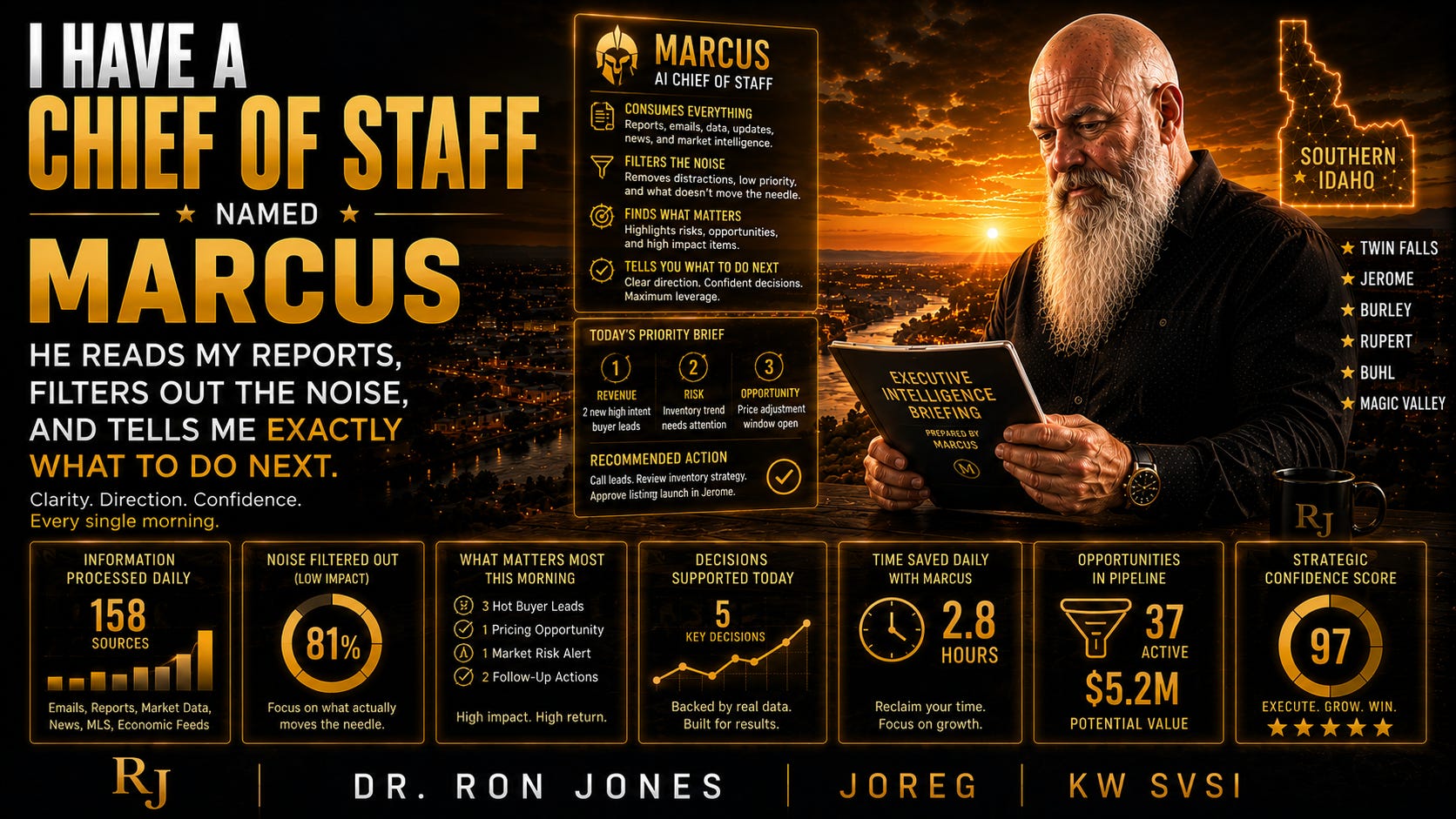
Most real estate agents are drowning in information and starving for clarity. They have data — from their CRM, from their email, from their transaction coordinator, from their lender — but nobody has synthesized it into a decision. Nobody has told them what matters today and what to ignore.
That’s the job I gave to Marcus.
I’m Dr. Ron Jones with JOREG | KW SVSI. I operate across the Magic Valley — Twin Falls, Jerome, Buhl, Gooding, Burley, Kimberly, and Southern Idaho at large. And Marcus is my Command Agent — Agent 2 in my 13-agent AI operating system. His title is Decision Engine. His job is to read my full Daily Intelligence Brief, strip out what doesn’t matter, and hand me a 9-section command brief that tells me exactly where to spend my attention today.
This article explains how Marcus works and why having a “chief of staff” layer above your raw intelligence is what separates reactive agents from operators.
The Problem Information Creates
Here’s the thing nobody talks about when they say “use AI for real estate.” More data doesn’t equal better decisions. In fact, more data without a filter creates decision paralysis.
When my Gmail Recon Agent Maya runs my Daily Intelligence Brief, she produces a 13-section HTML report. It covers urgent items, market data, showings, new leads, ISA activity, lender pipeline, team communications, schedule, active transactions, drift risks, and income forecast. It’s a complete picture of everything happening in my business.
But a complete picture is not the same as clarity. Reading 13 sections takes time. Figuring out what matters most requires judgment. Deciding who to call first requires contextual prioritization.
That’s where Marcus comes in.
What Marcus Does — The Command Brief
Marcus is not a summarizer. He is an executive operations filter. His instruction is explicit: prioritize business impact over volume. A single closing risk matters more than ten low-signal emails.
When I give Marcus my Daily Intelligence Brief, he produces a Command Agent Brief — nine sections, no fluff, designed for a field operator who needs to act:
Section 1 is Top 3 Command Priorities. Not ten things. Three. Each one comes with the action required, why it matters, the deadline or timing, and the expected outcome if I complete it.
Section 2 is Who I Need to Contact Today. Each person is ranked in order, with a specific reason, a recommended channel — call, text, or email — suggested timing, and a draft message ready to send.
Section 3 is Deals, Listings, or Pipeline Items at Risk. Only real risks. Property, the risk, what triggered the concern, the recommended intervention, and urgency: High, Medium, or Low.
Section 4 is the Team and Operations Watchlist. Which internal team communications need my attention, whether I need to respond, and a draft reply if needed.
Section 5 is Calendar and Execution Control. Conflicts, incomplete items, anything requiring prep, and what I can safely defer.
Section 6 is Money and Payout Outlook. Upcoming closings, expected timing, estimated net payout, confidence level, and what needs verification.
Section 7 is Market Posture for Today. What the market is doing, whether buyers or sellers have leverage, rate impact, and one specific action that should come from today’s conditions.
Section 8 is Ignore and Defer for Now. Items that appeared in the full report but don’t deserve my attention today. This section alone saves 30 minutes.
Section 9 is the Final Executive Take. Three bullets: today’s win condition, the biggest threat if ignored, and one strategic posture sentence for the day.
The Command Layer — What It Means for My Business
Before Marcus, I would read Maya’s full DIB and try to mentally organize it into priorities. That works — but it takes effort and judgment that I now don’t have to spend.
With Marcus, I open the Command Brief and the work is already done. The three most important things are in front of me. The people to call are listed in order with draft texts ready. The deals at risk are flagged. The money coming in is calculated. The noise is separated from the signal.
In a week where I’m managing active closings in Twin Falls and Buhl, new listings in Jerome, buyer searches across Gooding County, and a handful of reactivation leads, that clarity is the difference between a focused day and a scattered one.
Marcus doesn’t tell me what to feel about my business. He tells me what to do with my business. That’s the distinction that matters.
Why the Command Layer Is the Most Undervalued AI Use in Real Estate
Every agent who starts using AI goes after the obvious things: drafting emails, writing listing descriptions, generating social content. Those are fine. But the real leverage is in what I call the command layer — the intelligence synthesis layer that sits between raw data and executive decisions.
Maya gathers the intel. Marcus interprets it. Valentina acts on the leads. That’s an operating system. Not a tool, not a shortcut — an operating system that runs on AI and produces the same output a chief of staff, an ISA, and a transaction coordinator would produce, but faster, on demand, and without the overhead.
If you’re in real estate in Twin Falls, Jerome, Burley, or anywhere in Southern Idaho and you want to run your business this way — this is what I’m building at the HomeScores Academy and through Blue Ocean Strategies LLC.
Let’s talk.
— Dr. Ron Jones | JOREG | KW SVSI | Southern Idaho